
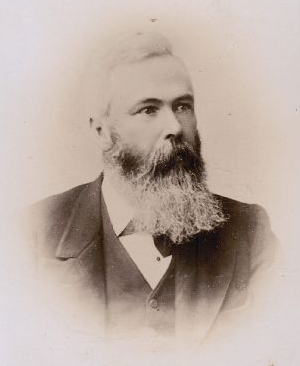
James Mullin, the only child of James and Bridgit Mullin, was born in 1846 at Cookstown, Northern Ireland. His father died that year, leaving the family in great poverty. His mother worked in the fields in the summer and for a weaving factory in the winter months, spinning flax. She was able to augment her income by letting one of the two rooms in the cottage to a family and growing potatoes on the land. James Mullin attended a local school, and by the time that he left at the age of eleven, was considered one of the best readers in the school. He developed a passion for reading.
After leaving school, he worked in the fields for two years. In spite of the long hours, he was able to continue his passion for reading by rising early. At the age of 13, he started on an apprenticeship as a wheelwright, working a 12 hour day.He continued with his reading, making use of books from the Cookstown Library, and joined the local debating society.
At the age of 22, his mother suggested that he leave work and spend time studying in order to enter the Cookstown Academy. Two years later, he gained a place at Galway University. Here he studied Latin, Greek, German, French and English and succeeded in becoming a Bachelor of Arts. He then switched to Medicine. He qualified from Queen’s University in 1880, at the age of 33. He moved to the UK and worked as a locum in various parts of the country. In 1882 he settled in Cardiff as a physician and surgeon and married Ann Mary Edwards:

 In 1884, his first child, Gladys Mary Mullin was born, followed by Justin James Patrick Mullin in 1887. Here is a photo of them in the garden of Conway Road in 1904.
His surgery was at 10 Customhouse Street. The location was carefully selected in the centre of Cardiff, accessible by trams. He became known as the shilling doctor, as this was the amount that he charged for a consultation. He worked extremely hard, seeing seventy to eighty patients followed by up to twenty home visits, each day, six days a week, for 25 years. This took a toll on his health. The following is the entry for him in the Medical Register for 1899:

The census entry for 1891 shows him living at 29 Ruthin Gardens:

 This is a Google Street view of the house.
In 1895 he purchased 56 Conway Road for £1,900. The following is the census entry for 1901:
The census entry for 1911 includes his daughter and son-in-law, together with two servants – a cook and a ‘general servant’.
He was interested in Irish politics and for 25 years was a Justice of the Peace. There are a number of reports in the Western Mail in the 1880’s and 1890’s that mention him. In 1886, Charles Parnell, the leader of the Irish Parliamentary Party, visited Cardiff and stayed with James Mullin.

 He somehow found time to be a poet and composed a 27 page booklet on the Battle of St. Fagans as the Prize Poem of the National Eisteddfod in 1899.


 On his retirement in 1908 due to ill-health and overwork, he travelled widely, visiting the Middle East and the West Indies.

 He wrote a 234 page biography entitled “The Story of a Toiler’s Life”, which was published in 1921. It was republished in March 2000 as one of the Classics of Irish History and is available from Amazon. There is a review of the book in the Irish Studies Review, Vol 7, No. 1, 1999.
There is an entry for James Mullin in the Dictionary of Irish Biography.
Extract from ‘Medical Men of Glamorgan‘
The following is an edited extract from the long chapter by Peter H Thomas on Medical Men of Glamorgan: James Mullin of Cardiff, 1846-1919. Pp 94-126 in Stewart Williams (Ed): Glamorgan Historian Volume 10 (Barry; Stewart Williams, 1974). At the end of the chapter acknowledgement is made of help from David Clark in the provision of photos and papers:
James Mullin left Blaenavon and went to London lodging in Huntly Street off Tottenham Court Road where he got in touch with several medical agents in order to find work. He acted as a locum in various parts of the country including with a Quaker family in Staines, a locum for a Welsh doctor in Ashby de la Zouche, a spell at a sixpenny dispensary in Bristol and finally some more colliery practice in the Ogmore Valley. He was now thinking of establishing a practice on his own account, rather than in partnership with another doctor and wondering where to set up. To solve the problem, he took a medical directory, compared the number of doctors to the population in all the chief towns of Great Britain and discovered that the ration was lowest in Preston, Barrow-in-Furness, Oldham, Wolverhampton and Cardiff. He decided to investigate each in turn starting with Cardiff, as a result of which he went no further. His choice was made.
Utterly alone in the world (and having complained of loneliness on a number of occasions hitherto in his later autobiography) he returned to London armed with a letter of introduction to a lady, Annie Mary Finco, the English widow of an Italian engineer. On the strength of a meeting at her London home (32 Shenley Road, Camberwell, S E London) the couple got married on 28 November 1882 and spent their honeymoon in Boulogne.
To use the doctor’s own words, parodied from Caesar – ‘veni, vidi, victus fui’. After marriage the couple settled in Cardiff. Their home was in Miskin Street where on 21 August 1884, their elder child Gladys Mary Celia was born. By 1886 they had moved to 29 Ruthin Gardens and, in the following year, their only son Justin James Patrick was born. Four years later they set up a permanent home at ‘Pendyrys’, 46 Conway Road, a fine Victorian house.
On his retirement Dr Mullin set off to visit the Middle East. He was joined in Cairo by his wife and her sister. Leaving Cairo they toured Cyprus, Beirut, Latakia and Sidon and thence to Jaffa and Jerusalem (though it is not clear if Annie was still with him). He was to travel extensively to the West Indies in 1906 and as a doctor on the steamers of the Yeoman Line. He died on 19 December 1919 aged 73
Like her husband Mrs Annie Mullin had a political turn of mind. Among her guests at ‘Pendyrys’ were Keir Hardie and Viscount Philip Snowden who was at one time Chancellor of the Exchequer. Highly intereste in the welfare of the Cardiff community she was for many years a member of the Board of Guardians and an active social worker. She died at her own residence on 21 January 1921 and was buried with her husband at Cathays Cemetery.
The following was written by David Clark in 1986:
Dr. Mullin’s Genealogy
According to a certificate dated 19th July 1967 given at Cookstown by the Parish Priest, Canon J. Mackle, James Mullin, son of James Mullin and Brigid Hagan, was Baptised according to the Rites of the Catholic Church of the Parish of Desertcreight and Derryloran, (Cookstown, County Tyrone) on the 23rd February 1846. His sponsors were Charles McNally and Rose Hagan.
A certified copy of an entry of death issued by the Superintendent Registrar of the District of Cookstown in the County of Tyrone dated 29th August 1967 states that on the 18th October 1874 at Loy (Cookstown), Bridget Mullan, widow aged 72 of Labourer died of Old Age & Debility, as informed by James Mullan present at death of the same address. There has been a memorial stone erected by the son in the parish churchyard.
A marriage certificate issued by the Church of Our Lady of Seven Dolours in Lower Park Road, Peckham, in the District of Camberwell in the County of Surrey, states that on the 28th November 1882 a marriage was solemnized by Licence between James Mullin aged 35, a Bachelor, Surgeon and Physician of 32 Shenley Road, Camberwell, whose father was James Mullin (Deceased), a Farmer, and Annie Maria Finco, aged 33, a Widow of no rank or profession, of the same address, whose father was George Edwards, House Proprietor. The witnesses were James Brand and Lucy Lawless.
It appears from a marriage certificate issued in Vienna that Eusebio Finco, an engineer from Italy, born on the 8th January 1839, son of Giovanni and Maria, was married to Anna Maria Edwards, born on the 5th October 1847 in England, on the 1st January 1877.
A certificate issued by Fabio Gambini of the Hospital of St. Maria of the Arcade of Grace and Consolation in Rome on the 28th December 1878 states according to the register of deaths, page no 1235, Finco Eusebio, Padua, of the late Giovanni and late Maria, aged 38, married industrialist of Catholic religion, came into the hospital from P.D. Via Eustachio no. 10 on the 13th February 1878 with a fracture of his left leg. Yesterday (… April 1878) about 10 o’clock p.m. he was given the last rites and spiritual absolution and departed from life, and is buried in Campo Verano. (The wording is as translated at the Italian Consulate, Park Place, Cardiff.)
A photograph of a memorial issued by A. Yeatman & Sons, sculptors, of West Norwood and Garnet Lane, Tooting, shows a head stone with the following inscription:- In Memory of GEORGE EDWARDS of Gravesend, Sergeant 1st Kent Artillery Volunteers, who died Oct. 15 1883 aged 79. FREDERICK JOHN Nov. 27. 1883, aged 32. ERNEST RICHARD, Jan. 26. 1883 at Wanganui, N. Z. aged 23. CECIL PERCY THOMAS, Jan. 22. 1896, at Veenen, Natal, aged 26. ANNE CATHERINE, wife of the above, died Dec. 22, 1901, aged 73.